
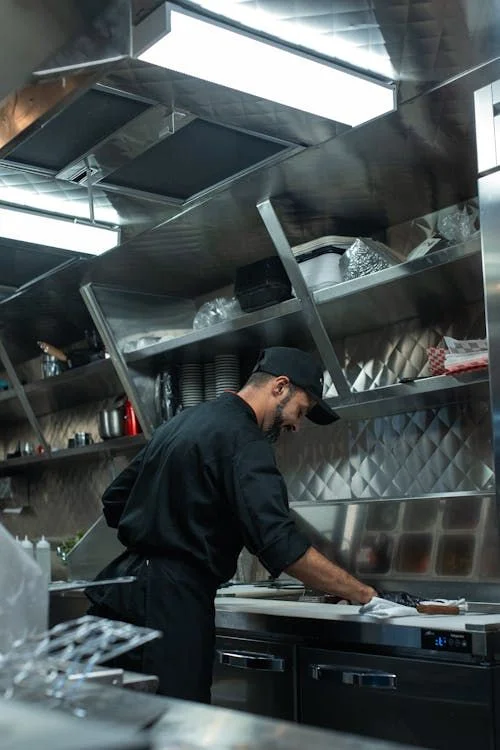
CLEANING SERVICES
Commercial Kitchen Cleaners Insurance
Cover built around kitchen extract cleaning: the ductwork you work on, hot works, and the certificates your clients ask to see.
You Are Signing A Certificate Someone Insures Against
Commercial kitchen cleaning insurance is essential for businesses in the food service industry to protect against various risks and liabilities. A comprehensive insurance policy tailored specifically for kitchen cleaning operations provides coverage for potential accidents, damages, and legal claims that may arise during cleaning activities. This includes coverage for damages to property, injuries to employees or third parties, and potential claims resulting from negligence or inadequate cleaning practices.
Moreover, with the high-risk nature of kitchen cleaning, including the cleaning of ducts, vents, and exhaust systems, specialised insurance coverage is crucial. Duct cleaning, in particular, poses significant risks due to the potential for grease buildup and fire hazards. Having insurance that specifically addresses these risks ensures that businesses are adequately protected in the event of accidents or damages related to duct cleaning operations.
What the cover is actually for is the financial consequence of the things that go wrong on this work: damage to the ductwork you were cleaning, a fire that starts during or after hot works, and injury to your own people. What it responds to in any given case depends on the policy terms, conditions, exclusions, limits and excesses.
We also cover other types of cleaning insurance including domestic, commercial, needle sweep & window cleaning.
TR19 And What It Means For Your Liability
TR19 is the specification most commercial kitchen extract cleaning is quoted, carried out and certified against. It sets out what "clean" means, how it is measured, and what evidence should accompany the work.
Your own policy does not usually require you to work to it. Your clients' policies effectively do. Their extraction cleaning condition is exactly what your certificate evidences, and their insurer will look at it after a fire.
Which makes the paperwork your defence as much as theirs. Pre- and post-clean readings, photographs of the areas cleaned, a record of what could not be reached and why, and a clear statement of scope. A certificate that claims more than was actually done is the document you least want to see produced in a claim.
How Much Is Duct Cleaning Insurance?
Kitchen extract cleaning starts at around £300 a year. Our wider cleaning book runs from about £57 for a sole trader up to £1,844 for larger contract businesses, and duct work sits well up that range because of the height work, the hot work near extraction, and the certification a client expects to see.
As a guide, our cleaning book overall runs from around £57 a year for a sole trader to £1,844 for larger contract businesses. A duct cleaning firm with engineers, height work and professional indemnity alongside its liability sits toward the upper part of that rather than the bottom.
Call 02382 000820 with your turnover and activities and we will get you a real number rather than a range.
Cover To Check
What a duct cleaning firm needs beyond public liability.
- Damage to the system worked upon
- Professional indemnity for certification
- Working at height, declared
- Hot work, if you cut or weld
- Confined space working
- Flexible payment options
- Dedicated account managers
- Out-of-hours contact should you need to make a claim or just have a question
- A quick and easy, pain-free service
- An excellent customer experience
Access, Height And Confined Spaces
Duct cleaning is rarely done standing on a floor. Roof-level fans and terminations bring working at height into it, ceiling voids and long horizontal runs bring access panels and sometimes confined space working, and both need declaring because they are rated separately from cleaning a canopy at arm’s length.
If you cut new access panels, that is alteration to the client’s ductwork and belongs in the same conversation as damage to property being worked upon. And if any part of the job involves hot work (cutting, grinding, welding a panel) say so, because hot work in a grease-laden duct is exactly the scenario insurers worry about, and permits and fire watch periods are usually conditions.
Damage To The System You Are Cleaning
Standard public liability generally excludes “property being worked upon”, and in this trade that is the ductwork, the canopy, the fan and the filters. everything you touch. Chemicals that damage a finish, a panel deformed on removal, a fan that will not restart after a clean: all of it lands in the exclusion.
The extension is called damage to property being worked upon, treatment risk, or custody and control depending on the insurer. Get the limit right as well as the wording. A commercial kitchen extract system is not cheap to put back, and taking a kitchen out of service while you do can bring a business interruption claim behind it.
Professional Indemnity, Not Just Liability
This is the part that separates duct cleaning from general cleaning. When you issue a certificate confirming a system has been cleaned to standard, you are giving a professional opinion that other people rely on, and if a fire follows and the report is challenged, the allegation is that your assessment was wrong rather than that you damaged something.
That is a professional indemnity claim, and public liability was not written for it. Any firm issuing certificates, post-clean reports or verification photographs should be carrying professional indemnity cover alongside the rest. Premiums can be paid monthly or annually.
What We Need To Quote
Your annual turnover, how many engineers you employ, whether you issue TR19 or equivalent certification and post-clean reports, whether any work is at height or in confined spaces, whether you carry out any hot work or cut access panels, whether you also do grease trap or ventilation hygiene work, and your claims record for the last five years.
Protect Your Business
So why wait? Protect your business today with CoverTrade's comprehensive insurance coverage. Contact us now to schedule a consultation with one of our expert advisors.
Cover that often goes with this
The gaps we most often find sitting next to this policy.
- Professional indemnityYou sign a certificate the client's insurer relies on, and that is a professional judgement.
- Commercial cleaning insuranceFor the general contract cleaning alongside the duct work.
Common questions
Why does a duct cleaning firm need professional indemnity?+
Because you issue a certificate that other people rely on. When a kitchen extract system is cleaned and certified, the operator's own insurer treats that certificate as evidence the policy condition was met. If a fire follows and your report is challenged, the allegation is that your assessment was wrong, a professional judgement failing rather than accidental damage. Public liability does not respond to that; professional indemnity does. Any firm signing off cleans should carry both.
Does public liability cover damage to the ductwork I am cleaning?+
Usually not. Most wordings exclude 'property being worked upon', which in this trade means the ducting, canopy, fan and filters. Everything you handle. Chemical damage to a finish, a panel deformed on removal, a fan that does not restart afterwards: all of it falls in the exclusion. The extension is called damage to property being worked upon, treatment risk or custody and control, and the limit matters because taking a kitchen out of service can bring a business interruption claim behind the repair.
What is TR19 and does my insurance depend on it?+
TR19 is the industry specification for internal cleanliness of ventilation systems, and it is the standard most commercial kitchen extract cleaning is specified and certified against. Your own insurance does not usually require you to work to it, but your clients' policies effectively do. Their extraction cleaning condition is what your certificate evidences. Working and certifying to a recognised standard, with photographic evidence and pre- and post-clean readings, is also your best defence if a report is ever challenged.
Do I need to declare working at height?+
Yes. Roof-level fans and terminations mean height work, and it is rated separately from cleaning at low level. The same goes for confined space working in ceiling voids or long horizontal runs. Both are entirely insurable and both cause problems when they emerge at claim time rather than at inception.
What if the job involves hot work?+
Declare it specifically. Cutting, grinding or welding an access panel in a grease-laden duct is close to the worst-case scenario insurers picture in this trade, and cover for it normally comes with conditions: a hot work permit, removal of combustibles, a fire watch for a set period after work stops, and extinguishers to hand. Those conditions are enforceable, so if hot work is part of what you do, the procedure needs to be real.
How much is kitchen extract cleaning insurance?+
Kitchen extract cleaning starts at around £300 a year. Our wider cleaning book runs from about £57 for a sole trader up to £1,844 for larger contract businesses, and a duct cleaning firm with engineers, height work and professional indemnity sits toward the upper part of that. Call us with your turnover and activities for a real number.
What our customers say on Google
5.0average from 169 Google reviews
Related reading
Guides from our team on the cover discussed on this page.